
Why a national cancer study near US reactors must be conducted before any new expansion of nuclear power
By Joseph Mangano, Robert Alvarez | Bulletin of the Atomic Scientists
Published on September 12, 2025
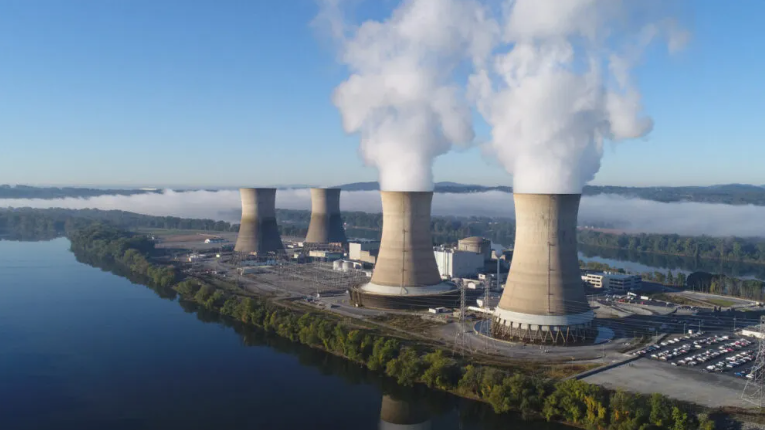
Editor’s note: This article is published after the passing away of Bob Alvarez. The draft manuscript was prepared by both authors. It has been lightly edited for style, length, and clarity.
Nuclear power reactors were introduced in the United States during the 1950s. Despite concerns about potential health hazards posed by routine radioactive emissions into the environment, few research articles have been published in professional journals. The only national study of cancer near reactors was conducted by federal researchers in the 1980s and found no association between proximity to reactors and cancer risk. But since then, articles on individual nuclear facilities have documented elevated cancer rates in local populations.
Current proposals to expand US nuclear power, along with concerns about protracted exposures near aging reactors, make it imperative that an objective, current national study of cancer near existing reactors be conducted.
Not required, not conducted. The first US commercial nuclear power reactor in Shippingport, near Pittsburgh, Pennsylvania, began operating in 1957. Eventually, 129 more reactors were built, 94 of which are still active today. From the outset, questions were raised about potential health hazards to people living near reactors, who were exposed to routine radioactive emissions into the air and water. Today, relatively little is known about the risk of cancer and other diseases from exposures to reactor emissions.
One explanation for this is the lack of regulations. Companies that operate nuclear reactors must measure and publicly report annual amounts of radioactive emissions into the environment, along with concentrations in air, water, and food. Keeping levels below “permissible limits” allows operators to retain their license. But no regulations have ever mandated that studies of local cancer rates be performed, or that cancer incidence or mortality does not exceed a particular rate.
The earliest analyses of cancer near US reactors focused on nuclear weapons workers. In 1964, occupational health expert Thomas Mancuso received an Atomic Energy Commission (AEC) grant to study cancer in workers at five sites. When Mancuso published results showing that cancer death rates were higher than expected, even in workers exposed to low-level doses, the AEC terminated his grant, stating he had reached retirement age. (Mancuso had no plans to retire.)
In late 1974, Washington State’s Health Department compared the mortality of different occupations in the state and found that:
“Men who worked at the Atomic Energy Commission Hanford facility in Richland Washington showed increased mortality from cancer, especially in men under age 64 at death.”[1]
The state decided not to make these findings public after Hanford’s scientists quietly verified the state’s findings. The heavy-handed effort to suppress the work of Mancuso—and that of his colleagues, Alice Stewart and George Kneale—helped speed the removal of the AEC from the oversight of worker health studies.
In 1990, following an investigation by the Governmental Affairs Committee in which the Energy Department’s contractors destroyed 20 filing cabinets of Oak Ridge hospital records of exposed workers set aside by Mancuso, the Energy Department transferred funds and management to the National Institute for Occupational Safety and Health, the federal agency responsible for research and policy recommendations for the prevention of work-related health risks. By late 1999, in addition to Hanford, workers at 13 other nuclear facilities were found to be dying from cancers and other diseases following exposure to radiation and other hazardous substances. These data provided the evidence for the passage of the Energy Employees Occupational Illness Program Compensation Act in 2000. Currently, 109,000 nuclear workers have been awarded compensation for illnesses and deaths following exposure to ionizing radiation and other toxic substances.
Studies of nuclear weapons plant workers have continued. A 2023 journal article included 310,000 workers at American, British, and French nuclear weapons plants, tracking their health status for an average of 35 years. The article documented a significant association between protracted occupational exposures and the risk of dying of cancer, even among those with very low exposure levels—well below those who survived the atomic bombs at Hiroshima and Nagasaki.
Despite these findings, government officials have strongly resisted any evidence that radioactive exposures from nuclear reactors are associated with a higher risk of cancer. As a result, few academic-based researchers—many whose research funding was highly dependent on government grants—addressed the topic, fearful of professional repercussions. These factors denied the public knowledge about the accrued risk of cancer near nuclear power plants, even as more of them started operating.
A single national study—and a cancelled one. One of the few independent research articles that analyzed cases of cancer near a US nuclear plant was published in 1987 by Richard Clapp, a Boston University epidemiologist. The study documented elevated rates of leukemia among persons who lived near or worked at the Pilgrim nuclear power plant in Plymouth, Massachusetts. Results were reported in the media, and word reached Democratic Sen. Ted Kennedy of Massachusetts, who was chairing the Senate Committee on Labor and Human Resources.
In January 1988, Kennedy wrote James Wyngaarden, then-director of the National Institutes of Health (NIH).[2] Citing the 1979 partial reactor core meltdown at the Three Mile Island nuclear plant and Clapp’s recent Pilgrim study, Kennedy urged the NIH “to conduct an appropriate inquiry into this entire question” of whether releases from nuclear plants were a causal factor in cancer. Wyngaarden replied to Kennedy in January, stating the Pilgrim article and other such studies in the United Kingdom:
“has led us to initiate a large-scale evaluation of cancer deaths occurring among persons living near the over 100 reactors operating in the United States … from the 1950s through the early 1980s with reactor operations.”[3]
Wyngaarden’s assertion that the NIH had already initiated a comprehensive study probably surprised Kennedy, who just days earlier had called for such an effort to begin. Wyngaarden’s response also showed that he was skeptical about the possibility that reactor emissions could raise cancer risk:
“The most serious health impact of the Three Mile Island accident that can be identified with certainty is mental stress to those living closest to the plant, particularly pregnant women and those with teenagers and young children.”
The National Cancer Institute committee of researchers produced a report in July 1990.[4] It included cancer mortality data from 1950-1984 for home and adjacent counties near 10 weapons plants and 52 power plants, covering over 900,000 local cancer deaths. The report’s introduction mentioned 31 peer-reviewed journal articles that had found elevated cancer rates near nuclear facilities—with only three from the United States: the Clapp study in the Lancet scientific journal, a follow-up letter to Lancet, and an article on the San Onofre plant in California. The National Cancer Institute committee concluded that “the survey has produced no evidence that an excess occurrence of cancer has resulted from living near nuclear facilities.”
The report, however, noted several limitations.
Many of the 62 plants had only been operating for a relatively small number of years, not enough time for the effects of radiogenic exposure to appear in workers and the nearby population. Moreover, cancer incidence data were only available for four plants, as most states did not have established cancer registries. Some cancers sensitive to radiation—such as childhood leukemia and thyroid cancer—have high survival rates, making incidence data more helpful than mortality.
In May 2009, the US Nuclear Regulatory Commission (NRC)—a successor to the old AEC— issued a public announcement of its intention to conduct an updated analysis of cancer near US nuclear plants. Initially, the NRC selected the Oak Ridge Institute for Science and Education to conduct the study. But after concerns were raised with the selection, led by then-Democratic Rep. Ed Markey of Massachusetts, the NRC reassigned the project to the National Academy of Sciences.
The Academy held multiple meetings and heard testimony from scientists and citizens. It issued a first report recommending study designs and a feasibility study using seven nuclear plants. A second report addressed pilot planning and execution. But actual results were never produced, and in September 2015, the NRC cancelled the study, citing the $8 million required in federal funds and claiming that the levels of radioactive emissions were too low to raise cancer risk anyway:
“Continuing the work was impractical, given the significant amount of time and resources needed and the agency’s current budget constraints. The NRC continues to find U.S. nuclear power plants comply with strict requirements that limit radiation releases from routine operations. The NRC and state agencies regularly analyze environmental samples from near the plants. These analyses show the releases, when they occur, are too small to cause observable increases in cancer risk near the facilities.”
The abrupt halt of the study drew numerous comments opposing the move. A Boston Globe editorial stated that in killing the nuclear cancer study, the NRC acted “more like an industry booster than a watchdog.”
Studies on individual plants: Few in number, opposed by government. Other than the 1990 National Cancer Institute study, little research on cancer near nuclear reactors has been published in scientific journals, and those studies that have often focused on a single plant. The most-studied plant was Three Mile Island, the site of a partial meltdown in 1979. But many journal articles on the meltdown’s health effects addressed stress-related illness and psychological suffering—not radiation-induced cancer.
It was not until 1990 that a peer-reviewed journal article was published on cancer near Three Mile Island. A Columbia University team reported that newly diagnosed cancer cases in the 10-mile radius around the plant had increased by 64 percent (1,722 to 2,831) in the five years after the meltdown. But the authors concluded there was no connection between these accrued cases of cancer and radioactive releases from the plant.
In 1997, a team from the University of North Carolina reanalyzed the data from the Columbia University study and did find an association between the meltdown’s releases and increased cancer risk. The Columbia University team blasted the University of North Carolina reanalysis, calling it “poor science … advocacy parading as science… full of misconceptions, misinterpretations, mistaken logic, and simple error.”
Since the late 1980s, the Radiation and Public Health Project research group—a New York-based nonprofit educational and scientific organization directed by one of the authors (Joseph Mangano)—published several dozen journal articles on radiation exposure and cancer, including trends and patterns in thyroid cancer near the Indian Point plant in New York, all cancers near the Salem plant in New Jersey, and childhood cancer near 14 plants in Eastern United States. The research group also found a link between trends in child cancer and strontium 90 (a radioactive isotope produced during the fission of uranium 235 in reactors) in baby teeth near the Indian Point and Oyster Creek (New Jersey) plants. This is the only study to ever analyze in-body radioactivity levels in the population living near US nuclear power plants.
In early 2024, Harvard University professor Petros Koutrakis and his research team launched two studies. The first study examined associations between cancer incidence in Massachusetts and proximity to nuclear power plants in New England. (This work is currently under review in a peer-reviewed journal.) The second study involved collecting indoor dust particles and outdoor soil near the Pilgrim nuclear plant, where radioactive particles emitted by the facility were identified.
National study of cancer near reactors needed. Many plans for expanding US nuclear power are now being proposed. The NRC has started granting life extension licenses for aging reactors for up to 80 years. Expansion plans also include restarting permanently closed reactors and building new reactors, including so-called “small modular” and “advanced” reactors. After the 2023 UN climate summit in Dubai, the United States and 21 other countries pledged to triple the global nuclear energy capacity by 2050. The federal government and some states have pledged billions of dollars in assistance to help achieve this goal.
These ambitious expansion plants are being proposed with little to no regard for the risks to human health from living and working at nearby nuclear reactors. Many industry leaders and government officials proudly claim nuclear power to be an “emission-free” energy source, but they ignore the health risks that routine radioactive emissions from reactors pose to the public, including cancer and other diseases. To address these claims, a new national study of cancer trends around the 94 existing nuclear reactors (nearly half of which are now 45 years old or more) must be conducted before any further expansion of nuclear power in the United States.
Such a national study of the health risks posed by existing reactors should:
At a minimum, update the findings from the 1990 National Cancer Institute study;
Estimate the time and resources needed to produce the first findings in less than two years.
Maximize the use of existing publicly available datasets; for instance, the Centers for Disease Control and Prevention website includes county-specific mortality data from 1968 to 2024.
Make results available to independent reviewers so they can reproduce the study;
Be funded by the federal government, which regulates nuclear power reactors;
Include only researchers who have no ties with the nuclear industry or the federal government, and are experts on the health effects of reactor emissions, having published in peer-reviewed journals already;
Make the results public by publishing them in peer-reviewed scientific journals and present them in public events alongside proposed plans for the expansion of nuclear power in the United States.
There can be no safe and publicly accepted expansion of nuclear power without an informed and transparent discussion over past and current health risks from US reactors to the population.
Notes
[1] Statement of Samuel Milham, M.D. Effect of Radiation on Human Health 1978, p. 495.
[2] Kennedy, Edward M. Chair, U.S. Senate Committee on Labor and Human Resources. Letter to Dr. James B. Wyngaarden, Director, National Institutes of Health. January 7, 1988.
[3] Wyngaarden, James B. Director, National Institutes of Health. Letter to Senator Edward M. Kennedy, January 28, 1988.
[4] Jablon S, Hrubec Z, Boice JD, Stone BJ. Cancer in Populations Living Near Nuclear Facilities. U.S. Department of Health and Human Services. National Cancer Institute. NIH Publication No. 90-874. July 1990. See also, Jablon S, Hrubec Z, Boice JD. Cancer in Populations Living Near Nuclear Facilities. A Survey of Mortality Nationwide and Incidence in Two States. JAMA. 1991;265(11):1403-1408. https://doi.org/10.1001/jama.1991.03460110069026